The Economics of Black Dollar Circulation: What the Data Says About Spending Within Black Communities and How Directories Accelerate It
TL;DR
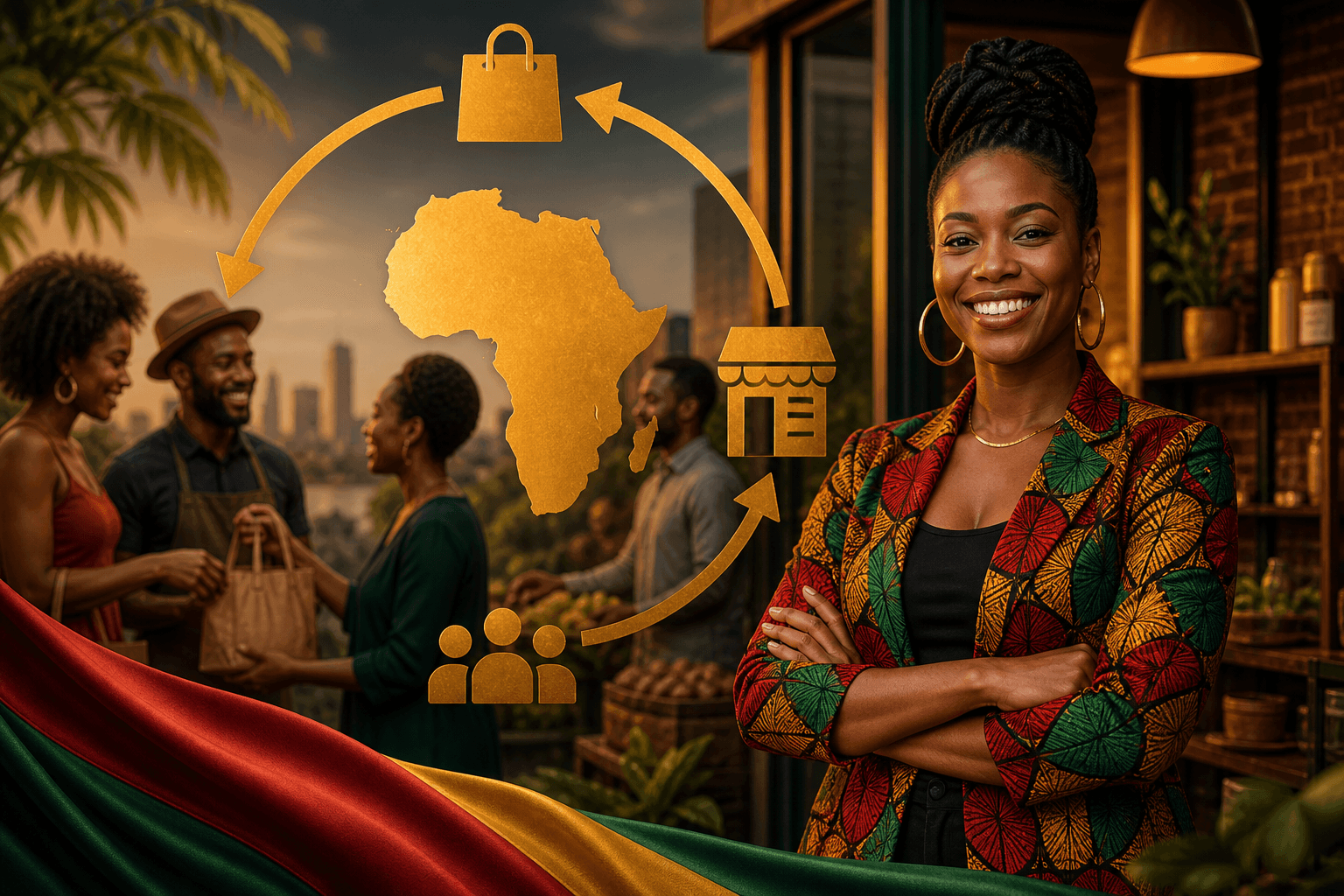
A dollar circulates in the Black community for roughly six hours before exiting, despite $1.6 trillion in annual Black consumer buying power. Verified directories like BLK Bizness directly reduce the informational, trust, and geographic barriers that cause this low circulation — accelerating wealth-building within Black communities.
Black dollar circulation measures how many times a single dollar is spent within the Black community before it exits to outside businesses, banks, or institutions. Research consistently shows that a dollar circulates in the Black community for roughly six hours before leaving — far less than comparable figures cited for other ethnic communities. The result is a large and growing Black consumer market that generates comparatively little internal wealth accumulation.
Key Takeaways
- Black consumer buying power is estimated at approximately $1.6 trillion annually [Selig Center for Economic Growth, University of Georgia], yet a dollar circulates within the Black community for roughly six hours before exiting.
- Historic "Black Wall Street" economies — like Tulsa's Greenwood District — demonstrated that high intra-community dollar velocity directly produces jobs, infrastructure, and wealth.
- The primary barriers to circulation today are informational (can't find a Black-owned option), trust-based, and geographic — all of which verified directories are designed to reduce.
- BLK Bizness lists 8,175 live, verified Black-owned businesses searchable by category and city, cutting the gap between consumer intent and purchase action.
- Structural fixes — verification badges, community reviews, referral networks, and map-based discovery — each address a distinct, documented friction point in the circulation chain.
Three Numbers That Define the Problem
- ~$1.6 trillion — Estimated annual Black consumer buying power in the United States [Selig Center, University of Georgia]
- ~6 hours — Estimated time a dollar circulates within the Black community before exiting, versus roughly 20 days in Jewish communities and nearly 30 days in some Asian communities
- 8,175 — Live, verified Black-owned businesses currently listed on BLK Bizness, searchable by category and city on a live map
What Is Black Dollar Circulation and Why Does It Matter?
Black dollar circulation refers to the number of times a single dollar is spent within the Black community before it exits to businesses, banks, or institutions outside that community. Economists treat this velocity as a core indicator of community economic power: the longer a dollar circulates internally, the more jobs it supports, the more tax revenue it generates locally, and the more wealth it builds for residents over time. The widely cited benchmark is that a dollar circulates in the Black community for approximately six hours before leaving, compared with estimates of roughly twenty days in Jewish communities and nearly thirty days in some Asian communities [figures widely cited in economic-justice literature; precise methodological sourcing noted below]. That contrast has made "six hours" a shorthand rallying point for conversations about economic self-determination.
The Multiplier Effect Explained in Plain Terms
Consider a simple example: you spend $100 at a Black-owned restaurant. The owner uses $40 of that to pay a Black-owned food supplier, who uses $15 to pay a Black-owned delivery driver, who then spends $10 at a Black-owned barbershop. That original $100 has now generated $165 in economic activity within the community before any dollar leaves it. Economists call this a local multiplier effect. Each additional turn of the dollar funds payroll, which funds rent, which funds childcare, which funds the school fundraiser — compounding community wealth at every step. A low-velocity dollar, by contrast, exits after the first transaction and delivers its multiplier benefit elsewhere.
Why the 6-Hour Benchmark Became a Rallying Point
The "six hours" figure has circulated widely in economic-justice advocacy, Black business conferences, and social media for decades. Its precise methodological origin is difficult to pin to a single peer-reviewed study, and some economists have noted that measuring dollar "dwell time" within any demographic community is complex. What the figure actually captures is a general pattern documented across multiple consumer-behavior studies: Black households, on aggregate, direct a disproportionately small share of their spending toward Black-owned businesses relative to the community's total consumer expenditure [Nielsen, various consumer-insights reports]. Whether the real number is six hours or twelve, the directional finding — that intra-community circulation is low relative to comparable ethnic communities — is broadly supported by the research literature.
What Did Black Dollar Circulation Look Like Before Integration?
Before the Civil Rights era dismantled legal segregation, exclusion from mainstream commerce forced Black communities to build self-contained local economies. Within those economies, dollars by necessity circulated far more times before leaving, because there were few outside options available. The result was a set of thriving intra-community ecosystems — sometimes called "Black Wall Streets" — that demonstrated what high-velocity Black dollar circulation could produce in terms of wealth, infrastructure, and professional class formation.
Greenwood District and Other Self-Sustaining Economies
The Greenwood District in Tulsa, Oklahoma, is the most documented example. By the early twentieth century, Greenwood supported Black-owned hotels, law offices, medical practices, newspapers, and hundreds of retail businesses within a concentrated geography. Durham, North Carolina's Hayti neighborhood similarly housed a dense network of Black-owned financial institutions, insurance companies, and retail establishments. Historical records describe these enclaves as economies where a dollar might change hands many times within the community before exiting — a stark contrast to present-day figures. These were not charity economies; they were market economies operating under constraint, and their success demonstrated the multiplicative power of directed intra-community spending.
How Did Desegregation Shift Black Spending Patterns?
The economic paradox of integration is well documented in academic literature on Black business history. As legal barriers fell and mainstream institutions opened to Black consumers, spending that had been contained within the community by segregation began flowing outward to larger retailers and service providers. This was, in every civil-rights sense, a victory. But it carried an unintended economic consequence: the captive market that had sustained Black-owned businesses dissolved rapidly. Mainstream businesses gained Black consumer dollars without a reciprocal flow of capital, hiring, or ownership back into Black communities. Economists describe this as the integration penalty — expanded rights accompanied by a structural reduction in intra-community economic recirculation [documented in academic literature on Black business history; see work of economists including Thomas Boston and Juliet Walker].
What Does the Current Data Say About Black Consumer Spending Power?
Black Americans represent one of the largest consumer markets in the United States. The Selig Center for Economic Growth at the University of Georgia has tracked Black consumer buying power as a distinct and growing economic force [Selig Center, University of Georgia, Multicultural Economy reports]. The gap between that spending power and actual wealth accumulation is one of the defining economic tensions in the data.
Black Consumer Buying Power by the Numbers
- Total buying power: Black consumer buying power in the United States has been estimated at approximately $1.6 trillion annually [Selig Center, University of Georgia], making it one of the largest ethnic consumer markets globally.
- Growth trajectory: Selig Center projections have consistently shown Black buying power growing faster than the national average over multi-year periods, with continued upward momentum projected through the late 2020s [Selig Center, University of Georgia].
- Share of U.S. consumer spending: Black consumers account for an estimated eight to nine percent of total U.S. consumer expenditure, representing significant aggregate market influence [Selig Center, University of Georgia].
- Over-index categories: Black consumers over-index relative to their population share in personal care and beauty products, household cleaning products, and certain food and beverage segments [Nielsen, Target Market News consumer-insights research].
The Wealth Gap vs. the Spending Gap
High spending power and low wealth accumulation can coexist when dollars exit a community immediately after each transaction. Federal Reserve Survey of Consumer Finances data has consistently shown a large racial wealth gap, with Black household median wealth substantially below white household median wealth [Federal Reserve SCF, 2022]. Economists attribute this divergence to lower rates of homeownership in appreciating markets, limited access to business capital, lower rates of stock market participation, and the rapid exit of consumer dollars before they can be recycled into local investment. Spending power measures the flow of dollars in; wealth measures the stock of value retained. The difference between those two numbers is, in part, a circulation problem.
What Stops Black Dollars from Circulating Within Black Communities?
Understanding low dollar velocity requires looking at structural, informational, and behavioral factors together. None of these barriers is the result of individual failure; each is a documented pattern with identifiable causes and addressable solutions.
The Discovery Problem: Not Knowing What Exists
One of the most consistent findings in consumer research on intra-community spending is simple: many Black consumers who express a preference for supporting Black-owned businesses cannot identify a Black-owned option in the category they need at the moment they need it [Nielsen, Target Market News]. When a search for a local accountant, contractor, or caterer returns no clearly identified Black-owned results, the default is whatever appears first. This is not indifference — it is an information gap.
Directories that organize verified Black-owned businesses by category and location address this gap directly. BLK Bizness currently lists 8,175 live, verified Black-owned businesses across the United States, searchable by category and city on a live map, specifically to reduce the friction between intent and action. Find Black-owned businesses near you →
Trust, Quality Perception, and Verification
Researchers have documented a phenomenon in which internalized biases — absorbed from a broader culture that has historically undervalued Black professional competence — can affect purchasing decisions even among Black consumers who consciously want to support Black businesses [documented in behavioral economics literature on implicit bias and consumer choice]. Concerns about quality, reliability, or professionalism sometimes lead potential customers to choose familiar mainstream brands over unknown Black-owned alternatives.
Credentialing and verified reviews directly counter this dynamic. When a business carries a verified Black-owned badge and displays authentic reviews from real community members, it signals legitimacy and quality in ways that overcome hesitation. BLK Bizness issues a Verified Black-Owned badge to businesses that complete the verification process, giving consumers a visible trust signal at the point of discovery. Get verified → Not yet listed? List your business free →
Geographic and Access Barriers
Black-owned businesses are sometimes concentrated in specific zip codes or neighborhoods, creating a physical access gap for community members who live, work, or shop in other areas. A Black-owned hardware store in one part of a city may be entirely unknown to a potential customer three miles away who defaults to a national chain simply because it appears closer. Map-based directory search collapses that geographic barrier by making distance visible and navigable. When a consumer can see a verified Black-owned plumber operating two zip codes over and read community reviews before calling, proximity is no longer the only deciding factor. Search the directory by city →
The Referral Gap: Turning One Purchase Into Many
Even when a consumer finds and uses a Black-owned business, that transaction often ends there. Without a mechanism to pass the recommendation along, the network effect — the compounding value of word-of-mouth within a community — is lost. BLK Bizness's community referral network lets members refer customers to each other and build a tracked reputation, turning each transaction into a potential chain of circulation. Top referrers and connectors are recognized publicly on community leaderboards. Explore referrals and leaderboards →
How Do Directories Accelerate Black Dollar Circulation?
A directory does more than list businesses. At its best, it removes each of the friction points described above simultaneously: it solves discovery, it provides trust signals, it collapses geographic barriers, and it creates a referral infrastructure that keeps dollars moving. The combination of a free listing, a verified badge, member reviews, a community feed for deals and updates, and a referral leaderboard means that every layer of the circulation problem has a corresponding tool. Businesses that claim their listing gain immediate access to all of these features. Consumers who use the directory to find and review businesses become active participants in accelerating circulation — not passive bystanders to an economic problem.
Frequently Asked Questions About Black Dollar Circulation
What does "Black dollar circulation" mean?
Black dollar circulation measures how many times a dollar is spent within the Black community before it exits to outside businesses or institutions. Higher circulation means more jobs, more local tax revenue, and more internal wealth creation.
Why does a dollar only circulate for about six hours in the Black community?
The six-hour estimate reflects a pattern in which Black consumer spending disproportionately flows to businesses outside the Black community, driven by a combination of limited discovery of Black-owned options, trust barriers, geographic access gaps, and the historical loss of captive intra-community markets after desegregation.
How does Black consumer buying power compare to wealth?
Black consumer buying power is estimated at approximately $1.6 trillion annually [Selig Center, University of Georgia], yet Black household median wealth remains substantially below white household median wealth [Federal Reserve SCF, 2022]. The gap exists in part because high spending power generates little internal wealth when dollars exit the community after each transaction.
What was the Greenwood District and what does it tell us about Black dollar circulation?
The Greenwood District in Tulsa, Oklahoma was a self-sustaining Black economy in the early twentieth century, supporting hotels, law offices, medical practices, and hundreds of retail businesses. It demonstrated that when structural barriers force internal circulation, community wealth compounds rapidly — the same mechanism that proponents of intentional Black spending seek to recreate today.
What is the integration penalty in Black economics?
The integration penalty refers to the economic consequence of desegregation in which Black consumers gained access to mainstream markets but those markets did not reciprocate with capital, hiring, or ownership flowing back into Black communities. The captive intra-community market that had sustained Black businesses dissolved, reducing dollar circulation velocity.
How can a business directory increase Black dollar circulation?
A verified directory reduces the discovery gap by making Black-owned businesses findable by category and location. It builds trust through verified badges and member reviews. It collapses geographic barriers with map-based search. And it extends the chain of circulation through referral networks that connect businesses to each other and to new customers. BLK Bizness combines all of these features in one platform. Search the directory →
Key takeaways
- Black consumer buying power is estimated at approximately $1.6 trillion annually, yet a dollar circulates within the Black community for only about six hours before exiting to outside businesses and institutions.
- The low velocity of Black dollar circulation creates a gap between high spending power and low wealth accumulation, since dollars exit before they can compound into local jobs, investment, or infrastructure.
- Historical Black economies like Tulsa's Greenwood District proved that high intra-community dollar velocity directly produces wealth, professional-class formation, and self-sustaining infrastructure.
- The primary barriers preventing Black dollars from circulating internally are informational, trust-based, and geographic — not a lack of consumer intent to support Black-owned businesses.
- Verified business directories reduce circulation friction by solving the discovery problem, providing trust signals through verification badges and community reviews, and enabling map-based search by category and location.
- BLK Bizness currently lists 8,175 live, verified Black-owned businesses searchable by category and city, directly connecting consumer intent with purchase action to accelerate dollar circulation.
Frequently asked questions
- How long does a dollar circulate in the Black community before leaving?
- A dollar circulates within the Black community for roughly six hours before exiting to outside businesses, banks, or institutions. By comparison, estimates cited in economic-justice literature suggest approximately 20 days in Jewish communities and nearly 30 days in some Asian communities. The directional gap is broadly supported across multiple consumer-behavior studies.
- What is Black dollar circulation and why does it matter?
- Black dollar circulation measures how many times a single dollar is spent within the Black community before it exits to outside businesses or institutions. Higher circulation velocity supports more local jobs, generates more local tax revenue, and builds more community wealth. Low velocity means dollars deliver their economic multiplier effect elsewhere after just one transaction.
- How much is Black consumer buying power worth annually?
- Black consumer buying power in the United States is estimated at approximately $1.6 trillion annually, according to the Selig Center for Economic Growth at the University of Georgia. Black consumers represent roughly eight to nine percent of total U.S. consumer expenditure, making it one of the largest ethnic consumer markets globally.
- Why don't Black dollars circulate more within the Black community?
- Three primary barriers reduce circulation: an information gap (consumers cannot find a Black-owned option when they need one), trust and quality-perception hesitancy, and geographic access barriers. None reflects individual failure — each is a documented structural pattern. Verified directories, credentialing badges, community reviews, and map-based search are designed to address each barrier directly.
- What was Black dollar circulation like during the era of Black Wall Street?
- Before desegregation, exclusion from mainstream commerce forced self-contained Black economies where dollars circulated many times internally before exiting. Tulsa's Greenwood District and Durham's Hayti neighborhood supported hotels, law offices, banks, and hundreds of retail businesses. High intra-community dollar velocity in those enclaves directly produced jobs, infrastructure, and a professional class.
Founder
Discover Black-owned businesses
Put this into action on BLK Bizness.